
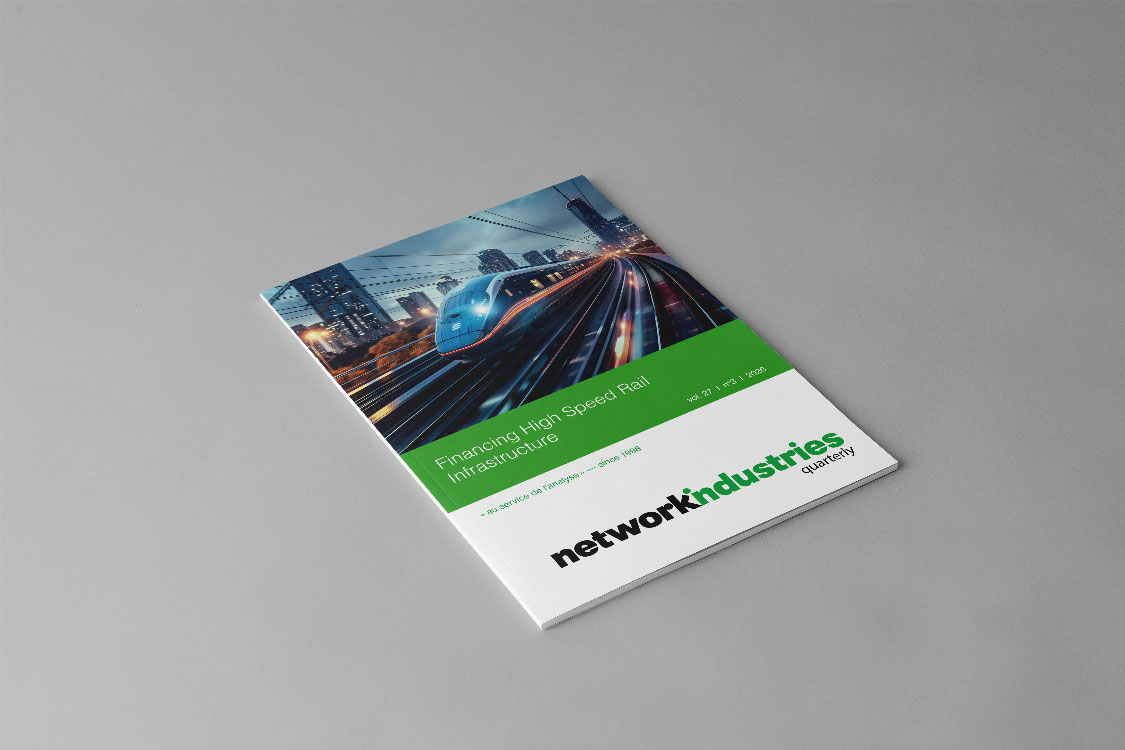
Financing High Speed Rail Infrastructure
At the European and international level, the development of high-speed rail is among the main priorities. However, the substantial investment required for such large-scale infrastructure projects cannot be expected to be fully financed by governments alone. Therefore, a more comprehensive understanding of financing options and models is pivotal in this context. This issue of Network Industries Quarterly explores diverse financing models available for rail infrastructure and examines how policymakers can balance risk, capital mobilisation and long-term sustainability. Michele Gesualdi’s contribution, entitled ‘Financing High-Speed Rail: Models, Trade-offs and the Path to Bankability’, shares that there is no single financing model for high-speed rail, with public delivery, PPPs and regulated asset base frameworks each suited to different institutional and fiscal contexts. Carbon finance emerges as a funding tool, and political commitment remains the key determinant of whether projects are delivered in an efficient, sustainable and fair manner. In his contribution, entitled ‘Learning to Share Risk: Lessons from PPPs in High-Speed Rail’, Prof. Juan Montero explains that after three decades of experience, high-speed rail PPPs have proven viable not by maximising risk transfer but by allocating risks to the parties best able to manage them. The public sector retains systemic risks and provides substantial support while private partners deliver construction and operational performance, even if at a higher financing cost than public procurement. Last, Russell Pittman, in his piece entitled ‘Financing Freight Railway Infrastructure: An Underappreciated Third Option?’, explains that the “competitive rules joint venture” model offers a potentially low-risk, scalable approach to rail reform that combines the European model’s intramodal competition and access charging with the Americas model’s reliance on private infrastructure investment, thereby providing both shipper choice and a sustainable source of capital.
Editors of this issue:
Juan Montero & Elodie Petrozziello
Books

Towards a smart and sustainable single European transport area : an assessment of the past 10 years of EU regulation

The Elgar Companion to Urban Infrastructure Governance

A Modern Guide to the Digitalization of Infrastructure

Infrastruktur Schweiz. Ein Erfolgsmodell in Gefahr

The Regulation of Turkish Network Industries